
Event Infrastructure Planning for Shorter Days
Your outdoor event starts at 4:00 PM. Sunset arrives at 6:30 PM. By 7:00 PM, guests are still eating, moving between activity areas, and using restrooms, but the daylight you relied on during setup has completely disappeared.
When daylight hours become shorter, event infrastructure must be planned as a connected system. Lighting affects power requirements. Power equipment affects walkway routing. Walkways affect furniture placement. And all of it must be installed and tested before the sun goes down.
This guide explains how to coordinate shelter, lighting, power, pathways, seating, guest facilities, and setup schedules for outdoor fall events in Northeastern Pennsylvania. The goal is a site that functions properly from arrival through departure, not a last-minute scramble to add lights after guests start tripping over extension cords.
What You'll Learn
- Begin with an event site plan and timeline
- Prioritize functional lighting across the event site
- Coordinate power needs before finalizing equipment placement
- Plan guest movement, access, and ground conditions
- Prepare essential event areas for cooler conditions
- Coordinate seating, service areas, and guest facilities
- Build a seasonal setup and event-day readiness timeline
- Use a fall event infrastructure checklist
Which type of organizer are you?
First-time event planner
You're organizing your first outdoor fall event and need to understand which infrastructure decisions affect each other before equipment arrives.
Returning organizer
You've coordinated events before but need a systematic approach for shorter daylight hours and multiple rental categories working together.
Venue or committee coordinator
You're managing equipment decisions for a group and need a practical checklist that prevents common planning gaps.
Begin With an Event Site Plan and Timeline
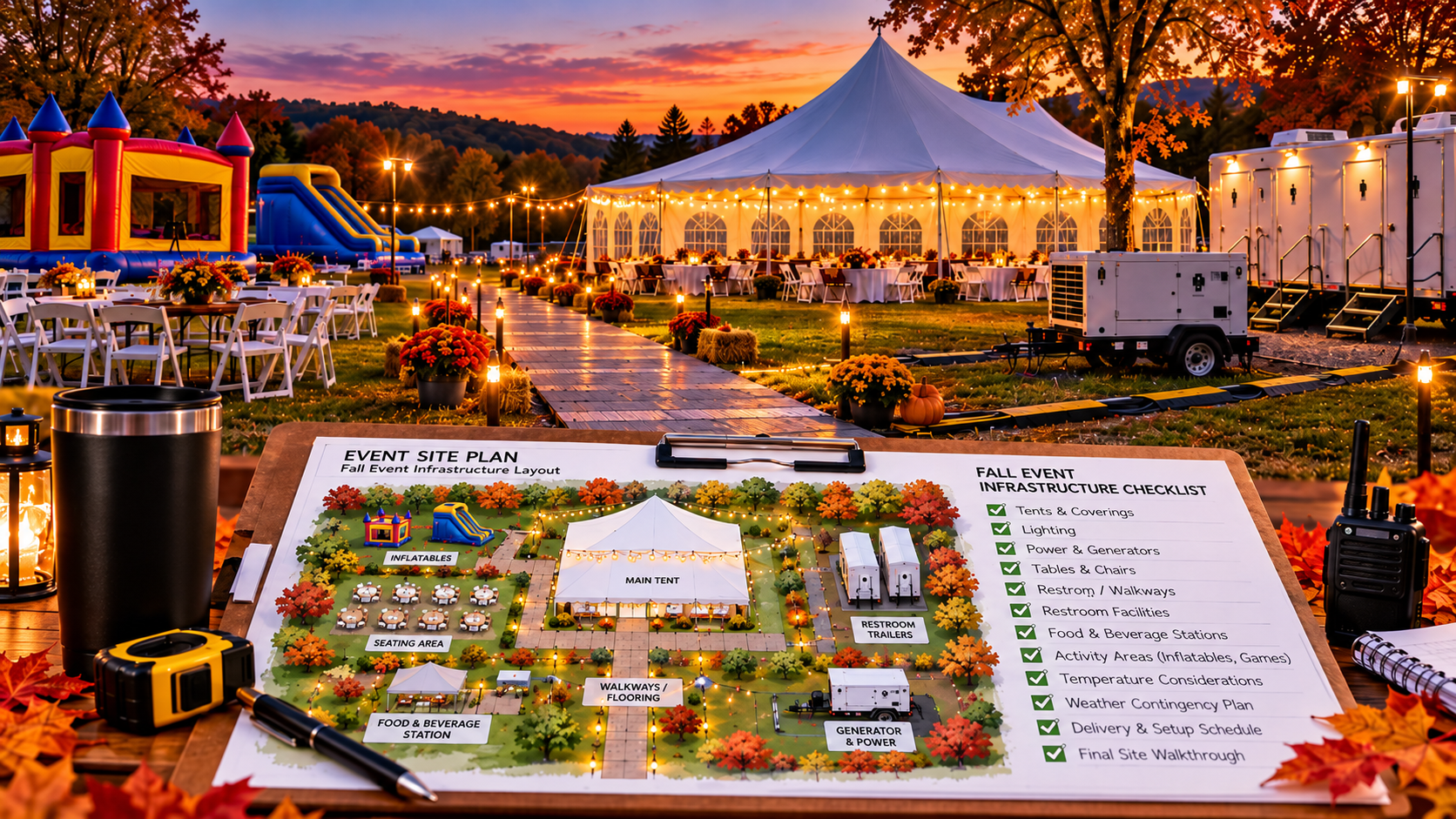
Equipment placement and setup schedules should be planned together, not in separate stages. A site map created before ordering rental equipment prevents expensive surprises like discovering your lighting placement requires power cables running directly across the main guest entrance.
Map the Areas Guests Will Use
Start by identifying these core zones:
- Main entrance (where guests arrive and depart)
- Event activity zones (games, entertainment, ceremonies)
- Seating and gathering areas (tables, conversation spaces)
- Food and beverage service (serving stations, buffet lines)
- Restrooms (portable facilities or building access)
- Main circulation paths (how guests move between areas)
- Equipment and service locations (generators, storage, staff areas)
- Emergency access routes (where applicable for the venue)
Once you know where guests will enter, gather, eat, and move between activities, it becomes easier to identify lighting, power, flooring, and access requirements. The site map isn't a decorative diagram. It's the foundation for every equipment decision that follows.
Plan Around the Event's Actual Daylight Window
Check the local sunset time for your specific date and location rather than relying on a generic seasonal estimate. In Northeastern Pennsylvania, October sunsets can range from around 6:45 PM early in the month to 5:45 PM by month's end.
Your timeline should account for:
- Event start and finish times
- Expected sunset for your date
- Setup and testing time needed before guests arrive
- Guest departure window
- Equipment removal arrangements (same-day or next-day pickup)
- The possibility of an event continuing 60-90 minutes after sunset
Pro tip: If your event starts at 4:00 PM and sunset is 6:15 PM, you have about 2 hours and 15 minutes of natural daylight after guest arrival. That's enough time for cocktails and mingling, but not enough for a full meal service and activities. Functional lighting must be operational before the sun goes down, not added when someone notices it's getting dark.
Prioritize Functional Lighting Across the Event Site
Decorative string lighting creates atmosphere. Functional lighting prevents injuries and keeps the event running smoothly after dark. Most outdoor fall events need both, but they serve completely different purposes.
Identify Areas That Need Reliable Visibility
Functional lighting is operationally necessary in these locations:
- Entrances and exits (guests need to see where they're going when arriving or leaving after dark)
- Main walking routes (pathways between activity areas, especially uneven ground)
- Dining and serving stations (guests need to see food, beverages, and table surfaces)
- Restroom approaches (clear visibility prevents guests from getting lost or walking into obstacles)
- Changes in ground elevation (steps, slopes, transitions between surfaces)
- Activity zones (areas where guests participate in games, entertainment, or ceremonies)
- Staff and service locations (where appropriate for event operations)
Separate Functional Lighting From Decorative Lighting
String lights hung inside a tent look beautiful but typically don't provide enough brightness for guests to safely navigate steps or read a buffet menu. Uplighting adds visual interest to trees or tent poles but doesn't illuminate the path to the restroom.
Decorative lighting sets the mood. Functional lighting handles the work. Plan for both, but don't assume decorative fixtures will cover your operational lighting needs.
Match Lighting Equipment to Its Intended Use
Different lighting types serve different purposes. CSE Services offers several options for outdoor fall events:
- Balloon flood light for area illumination (entrances, pathways, service zones)
- Battery-powered uplighting for accent and decorative purposes
- Vintage string lighting for tent interiors and covered gathering areas
When selecting lighting equipment, consider placement, power requirements, glare management, weather exposure, and installation needs. Browse sound and lighting equipment rentals to explore available options.
Important: Lighting equipment described for event use is not certified emergency lighting or guaranteed security lighting. Select equipment based on actual site requirements and manufacturer specifications, not assumptions about brightness or coverage area.
Coordinate Power Needs Before Finalizing Equipment Placement
Electrical demands influence where equipment can be placed, which walking routes remain practical, and whether your event needs a generator. Power planning isn't an afterthought. It's a core infrastructure decision that affects nearly everything else.
Identify Everything That Requires Power
Make a list of all powered equipment:
- Lighting (functional and decorative)
- Sound equipment (if used)
- Certain heating systems (if applicable)
- Food-service equipment (warming trays, coffee urns, refrigeration)
- Other electrical rental items
Determine actual equipment power requirements rather than estimating from appearance or device count. A single warming tray may draw more power than ten strings of LED lights. Startup loads for motors or compressors can temporarily exceed continuous operating requirements.
Confirm the Available Power Source
Ask these questions about your venue:
- Are outdoor electrical outlets available near the event area?
- What is the distance from power sources to equipment locations?
- Are existing outlets weather-rated for outdoor use?
- Can the available circuits handle your total electrical load?
- Do you need professional input to verify electrical capacity?
If venue power isn't available or adequate, you'll need a generator. CSE Services offers a 2,200-watt inverter generator suitable for many outdoor event applications.
Plan Cable Routes and Equipment Locations
Power cables and equipment placement must be coordinated with guest movement:
- Keep electrical cables away from walking routes where possible
- Use approved protection where routing across a pathway cannot be avoided
- Prevent trip hazards with proper cable management and visibility
- Maintain appropriate equipment clearances per manufacturer requirements
- Position generators outdoors away from tent interiors, occupied areas, building openings, and air intakes
Critical safety requirement: Generators must never be used indoors or inside tents or other enclosed spaces. Generator exhaust contains carbon monoxide, which is deadly. Always follow manufacturer placement requirements and maintain proper ventilation and clearances. Do not attempt DIY generator hookups without appropriate knowledge and equipment.
Plan Guest Movement, Access, and Ground Conditions
Safe and accessible movement routes aren't optional extras. They're essential infrastructure that must work throughout the evening, not just during daylight setup.
Identify High-Traffic Routes
Map the paths connecting:
- Entrance to main gathering area
- Seating to food service
- Main area to restrooms
- Activity zones to seating
- Parking or drop-off to entrance
These routes must remain clear and usable after tables are set, chairs are occupied, and equipment is installed. A pathway that looks fine on an empty field may become impassable once 60 guests are seated at tables.
Consider ground firmness, drainage, visibility at transitions, and surface-level changes. Fall weather in Northeastern Pennsylvania can include damp conditions that make grass slippery or create soft spots where equipment or foot traffic concentrates.
Evaluate Temporary Flooring Where Appropriate
Temporary flooring may be worth investigating for:
- Main entrance walkways
- Routes to restrooms
- Soft or uneven ground areas
- Transitions between surfaces
- High-traffic zones where grass may become damaged
CSE Services offers portable event flooring designed for outdoor events. Performance depends on proper installation, compatible surfaces, and actual site conditions. Temporary flooring is not automatically slip-resistant or accessible in every weather scenario.
For more detailed guidance on guest movement and site access, see the article on planning for crowd flow and guest comfort.
Prepare Essential Event Areas for Cooler Conditions
Temperature drops faster after sunset. October evenings in Northeastern Pennsylvania can start pleasantly mild and become noticeably chilly within an hour of darkness. Weather changes affect more than guest comfort. They influence equipment decisions, site preparation, and contingency planning.
Evaluate Shelter and Exposure
Identify which event areas are exposed and which are covered:
- Will guests spend most of the event under a tent or in open air?
- Are dining areas protected from wind and potential rain?
- Do tent entry locations create drafts or temperature changes?
- Are activity zones comfortable for the expected temperature range?
Tents provide shelter but may still require sidewalls, flooring, or heating depending on conditions and guest expectations. Explore party tent accessories to see available options for weather protection.
Consider Temperature Management Early
Heating equipment may be relevant depending on the venue, tent configuration, expected temperatures, and event duration. Temperature-management decisions should be made during the planning stage, not on event day when guests start complaining about the cold.
Avoid Conflicts Between Equipment and Guests
Heating units, power equipment, tent entrances, and walking routes must be coordinated. A propane heater positioned near a tent entrance may block guest flow. A generator placed too close to seating creates noise and exhaust concerns. Equipment that works fine during empty setup may become problematic when 80 guests are moving through the space.
Related reading: For detailed guidance on tent setup, weather considerations, and temperature management, see the companion article on tent setup considerations for cooler evenings and shorter days.
Coordinate Seating, Service Areas, and Guest Facilities
Tables, chairs, serving stations, and restrooms aren't independent elements. They're interconnected parts of the event infrastructure that must work together spatially and operationally.
Position High-Use Areas Before Selecting Quantities
Determine where these zones belong on your site map:
- Dining or seating near appropriate lighting and away from high-traffic intersections
- Service stations accessible without blocking primary guest routes
- Food-related equipment in locations with adequate power and workspace
- Sound or entertainment positioned to avoid conflicts with nearby conversation areas
- Restroom access clearly visible and well-lit after dark
Tables, chairs, serving equipment, and other items should be selected using a realistic plan of the usable site. Ordering 20 tables without knowing where they'll fit often leads to last-minute layout problems or insufficient space between seating groups.
Account for Guest Facilities
Restroom arrangements matter more after dark. Guests need to locate facilities easily, navigate the approach safely, and return to the event without getting disoriented.
For suitable events, CSE Services offers a two-unit restroom trailer that provides guest facilities with climate control and interior lighting. Restroom trailers aren't necessary for every outdoor event but can improve guest experience for longer gatherings or locations without building access.
Pro tip: Plan the route to restrooms as carefully as any other pathway. A well-lit, clearly marked approach prevents guests from wandering into equipment areas, service zones, or unlit sections of the site.
Build a Seasonal Setup and Event-Day Readiness Timeline
A practical operational sequence helps prevent the common problem of discovering infrastructure gaps when it's too late to fix them. This timeline reflects shorter daylight hours and the need to test equipment before guests arrive.
Planning Stage
- Confirm site and event requirements
- Identify likely equipment categories
- Check availability and rental arrangements
- Establish preliminary site layout
- Review relevant local requirements and permissions
Final Preparation
- Confirm delivery and setup responsibilities
- Review weather outlook
- Check event hours and sunset time
- Confirm power and lighting requirements
- Review contingency arrangements
Site Readiness
- Verify equipment installed per requirements
- Test lighting and powered equipment
- Inspect walking routes and entrances
- Confirm restrooms and service areas accessible
- Check site readiness for post-sunset conditions
Event Execution
- Maintain clear access routes
- Monitor changing weather and site conditions
- Follow equipment operating instructions
- Coordinate event conclusion
- Follow agreed rental collection or teardown arrangements
Sample event-day sequence (illustrative): Equipment delivery and installation (3-4 hours before event start) → power and lighting tests (2 hours before start) → guest-area inspection (1 hour before start) → guest arrival (event start time) → transition to evening lighting (around sunset) → guest departure (event end time) → agreed teardown or next-day collection.
Understanding Infrastructure Dependencies
Event infrastructure decisions aren't independent. One planning choice creates requirements or constraints for other elements. This table shows how initial decisions affect downstream planning:
| Initial Decision | What It Affects | Practical Implication |
|---|---|---|
| Lighting placement | Power requirements | Confirm electrical capacity and routing before finalizing light locations |
| Seating locations | Walking routes | Preserve usable paths after chairs are occupied and tables are set |
| Event end time | Lighting and departure | Confirm visibility through guest departure, not just main event hours |
| Restroom location | Access and lighting | Plan a practical, well-lit route to guest facilities |
| Equipment delivery | Setup sequence | Coordinate installation order before final site checks |
| Generator placement | Cable routing and access | Position outdoors with proper clearances, then route cables to equipment |
| Tent configuration | Interior layout capacity | Confirm tent size accommodates planned tables, seating, and circulation |
Use a Fall Event Infrastructure Checklist
This checklist consolidates the article's recommendations into a practical tool for coordinating multiple equipment categories and site requirements:
| Infrastructure Element | Planning Question | Potential Rental Consideration | Required Confirmation |
|---|---|---|---|
| Shelter | Do weather or temperature require covered areas? | Tents, sidewalls, flooring | Size, configuration, weather protection |
| Lighting | Where is functional visibility essential after dark? | Flood lights, string lights, uplighting | Coverage, power, placement, weather rating |
| Power | What is total electrical load and available capacity? | Generator, extension cords, distribution | Wattage, cable routing, outdoor placement |
| Walkways | Are main routes usable in expected conditions? | Portable flooring, lighting | Route clearance, surface condition, visibility |
| Seating | Where will guests sit and how many are expected? | Tables, chairs, linens | Quantity, layout space, access to other areas |
| Food Service | What serving arrangements and power does catering need? | Serving tables, power for warming equipment | Accessible location, electrical capacity |
| Restrooms | Are guest facilities accessible and visible after dark? | Restroom trailer (if no building access) | Location, approach lighting, capacity |
| Temperature | Do cooler evening conditions require heating? | Approved heaters (where applicable) | Equipment type, safe placement, ventilation |
| Timing | When is setup, testing, event, and teardown? | Delivery and collection coordination | Schedule allows pre-sunset equipment tests |
| Final Check | Is the site ready for conditions after sunset? | N/A | Walk-through inspection before guests arrive |
Frequently Asked Questions
What infrastructure should I plan for a fall outdoor event?
Plan for shelter (tents if weather is uncertain), functional lighting for pathways and activity areas, power sources for equipment, seating and dining arrangements, accessible walkways, guest facilities like restrooms, and a realistic setup schedule that accounts for earlier sunsets. Each element should be coordinated with the others rather than planned in isolation.
How do shorter daylight hours affect event setup?
Shorter daylight hours compress your usable setup window. Equipment installation, lighting tests, and site inspections must happen before sunset if you want to confirm everything works properly while you can still see clearly. An event continuing after dark requires functional lighting in place before guests arrive, not added as an afterthought.
What lighting should be considered for an outdoor evening event?
Prioritize functional lighting for entrances, exits, main walking routes, dining areas, serving stations, and restroom approaches. Decorative string lights or uplighting may enhance atmosphere but typically don't provide sufficient visibility for safe movement or task activities. Select equipment based on actual site requirements and power availability.
Do I need a generator for an outdoor fall event?
It depends on available power and your actual electrical loads. If the venue has accessible outlets that can handle your equipment, you may not need a generator. If power isn't available or adequate, you'll need to calculate total electrical demand and select a generator with appropriate capacity. Always verify equipment requirements and follow manufacturer guidelines for outdoor use and placement.
How can I prepare event infrastructure for changing fall weather?
Monitor the weather forecast leading up to your event. Confirm that tents, flooring, and other equipment are suitable for expected conditions. Review site access and drainage if rain is likely. Have a practical contingency plan that accounts for temperature changes, wind, or wet conditions without requiring a complete event redesign on short notice.
Plan Your Fall Event Infrastructure With CSE Services
Coordinating tents, tables, chairs, lighting, power, and other equipment for an outdoor fall event becomes simpler when you work with one provider. CSE Services offers multiple complementary rental categories, convenient online ordering, and complete party rental packages that can simplify your equipment selection process.
Planning an outdoor event in Northeastern Pennsylvania? Get the equipment plan started. Browse all event rentals and explore the tents, lighting options, tables, chairs, and accessories available for your fall gathering.
Book Online Now!No pressure, no pitch. Just practical rental solutions for your fall event infrastructure.