

Scaling Event Rentals for Fundraisers and Formal Gatherings
A local nonprofit begins planning a seated fundraising dinner. As the event develops, organizers add sponsor tables, guest registration, a silent auction, an awards presentation, and additional seating. What started as a straightforward tent-and-table rental order now requires several equipment categories, schedule coordination, and clearly assigned responsibilities.
Fundraiser event planning becomes more demanding when additional activities and guests are introduced. Rental quantities should be tied to the event's actual functions. Delivery timing, setup responsibilities, and venue limitations matter as much as equipment selection.
What You'll Learn
- Define the event's scale before building a rental list
- Build a rental plan around each fundraising activity
- Scale rental quantities without creating unnecessary costs
- Coordinate vendors and rental responsibilities before event week
- Build a rental timeline that supports the event schedule
- Protect the guest experience as your fundraiser becomes more complex
- Keep the rental budget focused on what matters most
- Common fundraiser rental coordination mistakes
📋 Nonprofit Organizers
You're coordinating a fundraising dinner or gala with multiple activities—registration, dining, auctions, presentations—and need to translate your program into a clear equipment plan.
🎪 Event Committees
Your committee is planning a formal gathering that's grown from 70 expected guests to 110, with added reception areas and sponsor recognition. You need to recalculate rental quantities and coordinate delivery.
💼 Corporate Coordinators
You're managing a company-sponsored charity event with speakers, dining, and multiple vendors. You need to clarify who's responsible for each rental category and confirm everything arrives on schedule.
Define the Event's Scale Before Building a Rental List
Rental requirements should be based on both the number of guests and the event's operational structure. Before requesting equipment, assess how your fundraiser actually functions.
Estimate Actual Attendance and Peak Equipment Demand
A 150-person event does not necessarily require every activity area to accommodate all 150 guests simultaneously. Consider expected attendees, volunteers and staff requiring space, vendors and service personnel, the ratio of seated versus standing attendees, peak simultaneous occupancy, and people moving between activities.
Some guests may arrive early for registration while others browse auction items. During dinner, nearly everyone needs seating. After presentations, guests might divide between conversation areas and entertainment zones. Calculate equipment needs based on the highest number of people using each space at the same time.
Identify the Activities That Drive Equipment Needs
Each element of your fundraising program creates specific rental requirements:
- Check-in and welcome reception — tables for registration materials, space for guest queuing, areas for sponsor recognition
- Seated dining — tables sized for your group arrangements, chairs for every seated guest, appropriate table covers
- Silent auction — display tables with adequate browsing space, lighting for item visibility
- Speeches and awards — podium or presentation area, sound system for speaker amplification, staging for visibility
- Live fundraising appeals — audio equipment that reaches the entire audience, clear sightlines to presenters
- Entertainment or dancing — appropriate flooring, lighting, sound support
- Food and beverage service — service stations, bar areas, circulation routes for staff
Pro tip: Write out your event timeline with 15-minute intervals. Note where guests will be during each segment. This reveals which spaces need equipment at which times—and whether certain rentals can serve multiple purposes throughout the event.
Review Venue Constraints Early
Your venue's physical characteristics and policies directly affect what equipment you can use and how it's delivered:
- Available space — total area, ceiling heights for indoor venues, outdoor ground conditions
- Existing furniture — what the venue provides versus what you need to rent
- Covered and uncovered areas — determines shelter requirements and weather contingency plans
- Delivery vehicle access — loading areas, path restrictions, parking for rental trucks
- Suitable surfaces for equipment — ground stakes for tents, level floors for staging
- Electrical access — power availability for sound, lighting, and presentation equipment
- Accessible guest routes — pathways that accommodate mobility devices and service flow
- Venue rules and approvals — restrictions on tent anchoring, equipment types, or setup timing
Contact the venue manager before finalizing rental selections. Confirm what equipment is permitted, where it can be placed, and when delivery trucks can access the site. Some venues require advance approval for tent installations or restrict certain anchoring methods.
Build a Rental Plan Around Each Fundraising Activity
The most effective rental coordination starts with your event program, not a generic equipment list. Translate each activity into specific equipment requirements, then organize those requirements into a coordination framework.
Arrival and Registration
Registration must accommodate guest arrivals without obstructing major access routes. Consider check-in tables for materials and volunteer stations, welcome stations for sponsor recognition or event programs, signage placement that directs guests clearly, adequate queue space during peak arrival times, and display areas for donor acknowledgment or event information.
Position registration near the entrance but away from dining or presentation areas. If weather is a concern for outdoor events, ensure this area has appropriate shelter.
Dining and Guest Seating
Furniture quantities depend on how many guests need seats at the same time and your chosen layout. Consider round tables for social conversation (typically seat 8-10), banquet tables for formal dinners or larger groups, chairs matching your event's formality level, table covers appropriate to the setting, guest-of-honor or sponsor seating with clear presentation views, and adequate space for service staff circulation.
Calculate seating based on confirmed guest counts plus a small buffer for last-minute additions. Avoid the temptation to drastically over-order. Empty tables look awkward and waste budget. Under-ordering forces uncomfortable crowding.
Fundraising and Presentation Activities
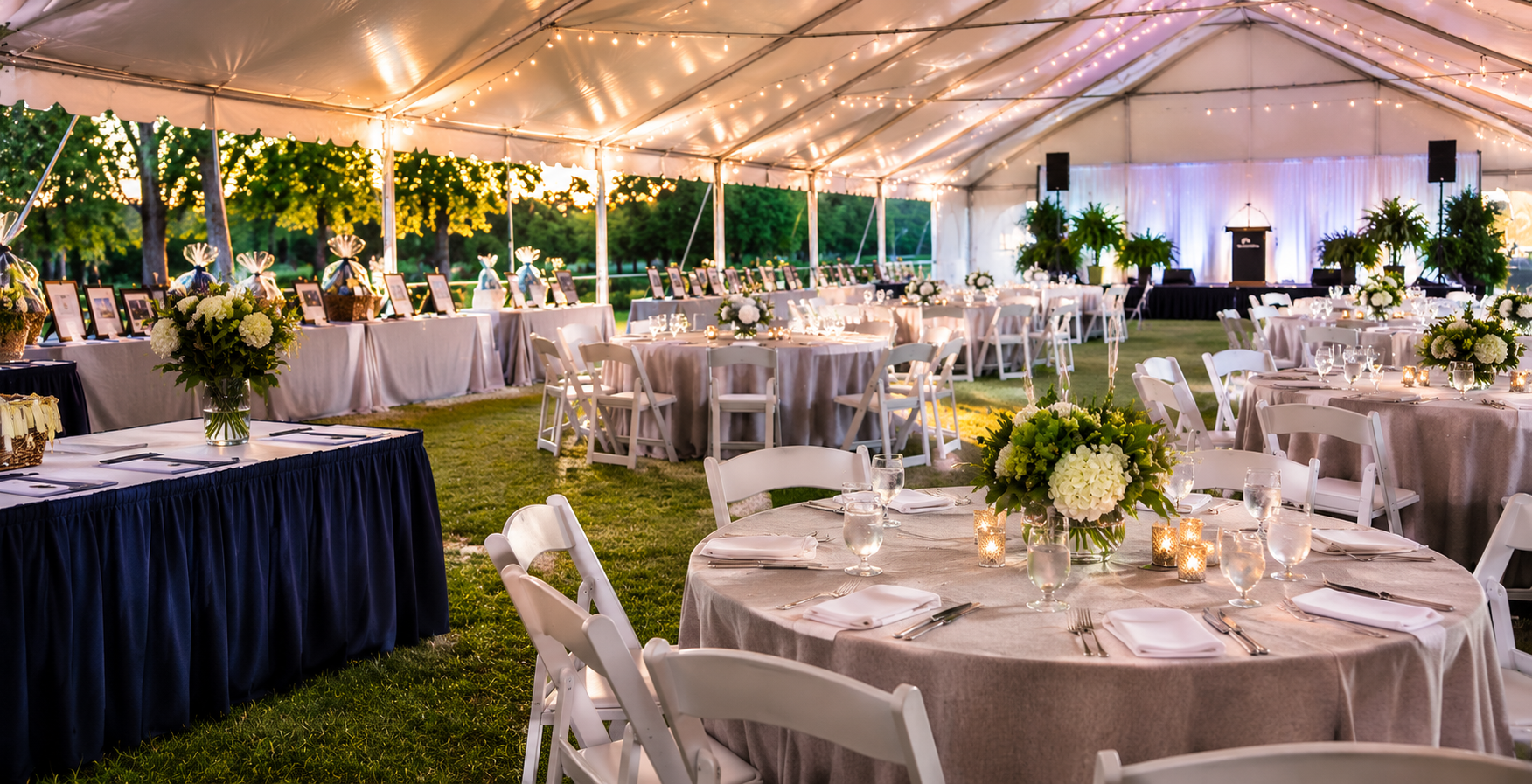
Presentations and fundraising appeals require equipment that supports speaker visibility and audience engagement. Consider auction display tables with browsing space, donation information areas clearly visible to attendees, a podium for speakers and award presentations, audio equipment that reaches the entire audience, appropriate lighting for speaker visibility and auction item displays, and staging or elevation if sightlines are limited.
Position the presentation area where most guests have direct sightlines from their seats. Test audio equipment during setup—not five minutes before your program begins.
Important: Confirm power requirements and electrical access for all presentation equipment before event day. Running extension cords across guest pathways creates safety hazards and looks unprofessional. Coordinate electrical needs with your venue and rental supplier during planning.
Reception and Supporting Areas
Reception spaces facilitate networking, beverage service, and guest movement between activities. Consider cocktail tables for standing conversations, beverage stations positioned away from traffic flow, appropriate covered areas for outdoor events, restroom facilities matching guest count and event duration, flooring for uneven or wet ground conditions, pathways that connect activity areas logically, and waste collection positioned discreetly but accessibly.
Reception areas work best when they're defined spaces, not leftover corners. Use furniture placement and tent accessories to create intentional gathering zones that feel welcoming rather than accidental.
Fundraiser Rental Coordination Matrix
Use this framework to organize equipment requirements by event function:
| Event Area | Equipment to Consider | Planning Consideration | Responsible Party |
|---|---|---|---|
| Registration | Tables, signs, queue management equipment | Arrival flow and volunteer access | Event coordinator |
| Dining | Tables, chairs, table covers | Seated guest count and service circulation | Rental supplier + setup crew |
| Silent Auction | Display tables, appropriate lighting | Browsing space and accessibility | Auction committee |
| Presentation | Podium, sound system, lighting | Speaker visibility and audio reach | AV coordinator |
| Reception | Cocktail tables, beverage stations | Standing capacity and guest movement | Venue + caterer |
| Supporting Facilities | Restrooms, flooring, waste bins | Venue conditions and guest comfort | Facility coordinator |
Add two columns when you use this framework for your event: "Confirmation Deadline" and "Final Status." This transforms a generic equipment list into a usable coordination tool that prevents last-minute confusion about who's responsible for what.
Scale Rental Quantities Without Creating Unnecessary Costs
As your fundraiser grows, recalculate equipment needs methodically rather than automatically increasing every rental quantity by the same percentage.
Start With Simultaneous Usage
Equipment quantities should be driven by the maximum expected number of people using each space at the same time. If 110 guests attend but only 90 sit for dinner while 20 browse the silent auction, you need seating for 90—not 110. When everyone transitions to the presentation, verify that total capacity accommodates the full group.
Track peak occupancy for each zone throughout your event timeline. This reveals true equipment needs rather than inflated totals based on attendance alone.
Separate Core Rentals From Supporting Rentals
Not all equipment carries equal importance. Distinguish essential rentals from nice-to-have additions:
↓ Core Needs (Essential)
- Adequate seating for all dinner guests
- Weather-appropriate shelter for outdoor events
- Tables for dining and registration
- Sound system for presentations
- Basic lighting for evening events
- Restroom facilities matching guest count
↑ Supporting Needs (Enhancements)
- Cocktail tables for networking areas
- Decorative tent accessories
- Upgraded chair styles
- Additional reception furniture
- Portable dance flooring
- Specialty lighting effects
If budget pressures arise, reduce or eliminate supporting rentals before compromising core functionality. Guests forgive the absence of cocktail tables more readily than insufficient seating or inadequate shelter.
Recalculate Quantities When the Program Changes
Example: Scaling from 70 to 110 guests with added activities
Initial plan: A 70-person seated fundraising dinner under a single tent with basic presentation equipment.
Revised plan: 110 expected attendees, plus a separate cocktail reception area and silent auction zone.
What changes:
- Seating: Increases from 70 chairs to approximately 95 (accounting for auction browsers during dinner)
- Tables: Add dining tables plus cocktail tables for reception area
- Shelter: Review whether existing tent accommodates expanded layout or requires larger size
- Activity tables: Add display tables for silent auction items
- Lighting: Extend coverage to new activity zones
- Floor plan: Reconfigure to separate dining, auction, and reception areas while maintaining circulation
Notice that the organizer adjusts specific categories based on how the event program changed—not by blindly increasing everything by 57% because attendance grew by that amount.
Critical insight: Contact your rental supplier when making significant program changes. Equipment availability, delivery logistics, and venue capacity may limit what adjustments are practical. Early consultation prevents discovering on event week that your revised plan isn't feasible.
Coordinate Vendors and Rental Responsibilities Before Event Week
A written responsibility list prevents equipment from arriving without a clear plan for where it goes or who sets it up.
Assign One Responsible Person for Each Rental Category
Document these details for every equipment group:
- Rental supplier: Company name and direct contact information
- Organizer contact: Who receives delivery calls and coordinates on-site
- Delivery location: Specific address, loading area, and access instructions
- Setup responsibilities: What the supplier installs versus what your team handles
- Site requirements: Electrical needs, ground conditions, clearance specifications
- Final confirmation status: Quantities verified, delivery scheduled, payment arranged
- Pickup arrangements: Collection timing, equipment protection, access coordination
Share this list with your event committee, venue manager, and all involved vendors. Everyone should know who's managing each equipment category and how to reach them quickly if issues arise.
Confirm Dependencies Between Vendors
Some equipment installations must happen in a specific order. Identify and communicate these dependencies early:
- Tent setup must be coordinated with the approved event layout and completed before interior furniture placement
- Flooring installation typically precedes table and chair arrangement
- Electrical connections for sound and lighting require access before final decorative installations
- Presentation equipment positioning depends on confirmed seating arrangements
- Caterers need table locations finalized before detailed service planning
Create a simple installation sequence: "Tent installed by Friday 3pm → Flooring placed Friday 5pm → Tables and chairs delivered Saturday 9am → Final setup complete by Saturday 2pm." Share this timeline with every involved party.
Confirm What Each Supplier Actually Provides
Renting equipment does not necessarily mean complete event production or on-site management. Different suppliers may be responsible for delivering, installing, positioning, operating, or removing specific items.
For example, CSE Services' larger rental equipment typically includes setup and teardown. Table and chair arrangement is generally a separate service available for an additional charge. Confirm these details during booking rather than assuming what's included.
Non-negotiable: Never assume setup is included. Ask directly: "What specifically does your company deliver, install, position, and collect? What tasks are my team's responsibility?" Get written confirmation. Discovering setup gaps on event day creates preventable disasters.
Build a Rental Timeline That Supports the Event Schedule
Coordinate booking, delivery, setup, event use, and pickup in a realistic sequence that accounts for equipment dependencies and venue access.
Reserve High-Priority Equipment Early
For events with 150 or more guests, consider booking at least six months ahead as a general guideline. Specific lead times depend on the supplier, season, event scale, and equipment availability. High-demand dates—spring and fall weekends, holiday periods—require earlier reservations.
Start by confirming your event date, venue, estimated guest count, and core rental requirements like tents, tables, and seating. Lock these in first, then add supporting equipment as your program details solidify.
Finalize the Equipment Plan Before Delivery
Complete these steps well before equipment arrives:
- Final guest estimate: Update counts and confirm corresponding equipment quantities
- Site layout: Document where each equipment category will be placed
- Equipment quantities: Verify final numbers with all suppliers
- Delivery details: Confirm addresses, access routes, parking for trucks, and delivery windows
- Venue approval: Ensure the venue has reviewed and approved your rental plan
- On-site contacts: Assign someone to receive each delivery and coordinate placement
- Setup responsibilities: Clarify what suppliers install versus what your team handles
Send a written summary to your rental suppliers confirming these details. This prevents miscommunication about quantities, locations, or timing.
Sequence Equipment Installation
Equipment dependencies determine installation order. Tents or approved covered areas generally need establishment before arranging furniture underneath them. Flooring should be in place before heavy furniture positioning. Electrical connections must be accessible before final decorative setups.
Build buffer time between installations. If tent setup scheduled for Friday afternoon encounters weather delays, you need flexibility before Saturday morning furniture delivery.
Coordinate Pickup and Venue Restoration
Confirm collection windows with rental suppliers and understand your responsibilities. Some suppliers collect equipment the next business day; others arrange specific pickup times. Protect rented items during the event—damage charges can surprise committees managing tight budgets.
Verify venue restoration requirements. Some sites require all equipment removed by a specific deadline or charge additional rental fees.
Fundraiser Rental Timeline
PHASE 1: Early Planning
Confirm date, venue, estimated attendance. Reserve core equipment like tents, tables, seating. Establish budget framework.
PHASE 2: Program Development
Finalize event activities. Add equipment for presentations, auctions, receptions. Update quantities based on program needs.
PHASE 3: Final Confirmation
Lock guest counts. Verify all equipment quantities. Confirm delivery details, setup responsibilities, vendor dependencies. Complete site layout.
PHASE 4: Delivery & Setup
Coordinate equipment installation sequence. Confirm on-site contacts for each delivery. Verify installations against your plan.
PHASE 5: Event Readiness
Complete final checks. Test sound and lighting. Verify accessibility. Confirm vendor coordination. Prepare contingency plans.
PHASE 6: Breakdown & Pickup
Coordinate equipment collection. Protect rented items during breakdown. Confirm pickup schedules. Restore venue per requirements.
Protect the Guest Experience as Your Fundraiser Becomes More Complex
Rental decisions directly influence guest comfort and participation during formal fundraising activities. Keep these priorities front of mind as you coordinate equipment:
Guest movement: Keep entrances, reception areas, dining spaces, and fundraising stations easy to navigate. Avoid creating bottlenecks where registration, beverage service, and auction browsing compete for the same pathways.
Seating comfort: Avoid overcrowded tables and blocked access. Standard banquet tables accommodate 8-10 guests comfortably—not 12 squeezed together. Leave adequate space between table groupings for guest and service circulation.
Presentation quality: Ensure guests can see and hear speeches or fundraising appeals from their seats. Position the presentation area centrally with clear sightlines. Test audio equipment during setup to confirm reach throughout the space.
Weather readiness: For outdoor events, confirm suitable shelter and develop weather contingency arrangements. Even partial rain coverage matters—guests tolerate temperature variations more gracefully than getting soaked during dinner.
Accessibility: Consider accessible routes and seating locations based on the venue and applicable requirements. Position accessible seating with comparable views and convenient access to facilities.
Supporting facilities: Review restroom access, waste collection, lighting for evening events, and flooring for uneven or wet ground conditions. These details fade into the background when handled well—and dominate guest memory when neglected.
Keep the Rental Budget Focused on What Matters Most
Nonprofit committees must prioritize rental expenditure without sacrificing essential functionality.
Separate Essential Equipment From Optional Enhancements
Prioritize equipment that supports guest capacity, basic comfort, accessibility, and the core event program. These are non-negotiable. Everything else becomes optional when budget pressures arise.
If you're choosing between adequate seating and upgraded chair styles, choose seating. If you're deciding between functional lighting and decorative lighting effects, choose functional. Build the base event successfully, then add enhancements only when budget allows.
Compare the Full Rental Cost
Budget for more than equipment rental rates. Account for:
- Equipment rental rates for all categories
- Delivery fees based on distance and equipment type
- Optional setup charges when arrangement isn't included
- Necessary accessories like tent sidewalls, lighting, or flooring
- Electrical arrangements if power isn't readily available
- Deposit requirements and payment schedules
- Potential damage fees if equipment protection is inadequate
Request detailed quotes that separate base rental costs from additional services. This transparency helps you make informed decisions about which optional services provide real value.
Review Multi-Item Rental Options
Using one provider for several categories can simplify purchasing and delivery coordination. Single-supplier orders reduce the number of delivery schedules to manage, payment processes to track, and contacts to coordinate on event day.
That said, verify any package or multi-item rental matches your actual needs. Don't add unnecessary items just because they're bundled. Compare whether ordering categories separately from specialized suppliers provides better value or quality for your specific event.
Common Fundraiser Rental Coordination Mistakes
Learn from these avoidable operational mistakes:
🚩 Reserving by guest count alone
The problem: Ordering equipment based solely on total attendance without considering event activities, staffing needs, service areas, and peak simultaneous usage.
The fix: Map your event program and calculate equipment needs by activity zone and simultaneous occupancy, not just total guest count.
🚩 Adding rentals without updating the floor plan
The problem: Increasing table quantities, adding cocktail tables, or expanding activity areas without verifying that everything actually fits in your space with proper circulation.
The fix: Review the complete layout whenever the event program changes. Confirm with your venue that the revised plan works within available space.
🚩 Assuming setup is included
The problem: Believing that all rented equipment arrives ready to use, only to discover on delivery day that table arrangement, chair placement, or equipment positioning is your team's responsibility.
The fix: Confirm exactly what is delivered, installed, positioned, and collected. Get written clarification about setup responsibilities before booking.
🚩 Leaving responsibilities unclear
The problem: Multiple vendors, committee members, and venue staff all assume someone else is handling critical details like electrical connections, equipment positioning, or delivery coordination.
The fix: Document vendors, assigned contacts, specific deadlines, and task dependencies. Share this coordination list with everyone involved.
🚩 Making late changes without checking availability
The problem: Deciding two weeks before the event to add 30 chairs, expand the tent, or include presentation equipment—then discovering the items aren't available or delivery can't be rescheduled.
The fix: Establish a final equipment review deadline. Contact suppliers immediately when requirements change. Accept that some late additions may not be possible.
Fundraiser Event Rental Coordination Checklist
Use this checklist when gathering information for rental quotes and coordinating your fundraiser:
- ✓ Confirm event date, location, and expected attendance
- ✓ Outline all event activities and operational zones
- ✓ Identify existing venue equipment and what must be rented
- ✓ Separate essential rentals from optional items
- ✓ Estimate equipment quantities by simultaneous need
- ✓ Confirm tent, furniture, and accessory requirements
- ✓ Review power and sound requirements for presentations
- ✓ Confirm accessible routes and guest comfort needs
- ✓ Assign a contact person for each supplier category
- ✓ Clarify delivery, setup, and pickup responsibilities
- ✓ Verify rental pricing and additional service charges
- ✓ Confirm equipment availability and reservation terms
- ✓ Review the final floor plan with venue and suppliers
- ✓ Communicate the installation schedule to involved vendors
- ✓ Complete a final readiness check before guest arrival
Frequently Asked Questions
What rentals do you need for a fundraising event? +
Requirements vary by guest count, venue, and activities. Common categories include tables, chairs, tents, sound equipment, lighting, and supporting facilities. Base your rental list on the event's actual program—registration needs tables, dining requires seating, presentations demand audio visibility, and receptions benefit from cocktail tables and appropriate shelter.
How do you plan rentals for a large fundraising event? +
Start with the program and expected attendance. Map activity areas like check-in, dining, auctions, and presentations. Estimate quantities based on simultaneous usage rather than total guests. Review dependencies between equipment types, confirm delivery and setup responsibilities, and document who manages each rental category through event day.
How far in advance should fundraiser event rentals be booked? +
High-demand equipment and larger events should be reserved early. For events with 150 or more guests, consider booking at least six months ahead as a general guideline. Specific lead times depend on the supplier, season, event scale, and equipment availability. Confirm reservation timelines directly with your rental provider.
How can nonprofits keep event rental costs under control? +
Prioritize essential functions over optional enhancements. Calculate appropriate quantities based on actual simultaneous usage. Compare complete costs including delivery, setup charges, and accessories. Confirm what services are included versus additional fees. Choose equipment that directly supports your program rather than inflating every category by the same percentage.
Simplify Fundraiser Rentals With CSE Services
CSE Services provides quality event rental equipment for fundraisers and formal gatherings across Northeastern Pennsylvania. We offer tents, tables, chairs, sound and lighting equipment, flooring, and supporting accessories—with convenient online ordering and customer-focused service.
Whether you're coordinating a nonprofit gala, charity dinner, or community fundraising event, our rental inventory supports events of various sizes and complexity levels. For more complicated requirements or questions about equipment combinations, delivery details, and availability, contact us directly.